

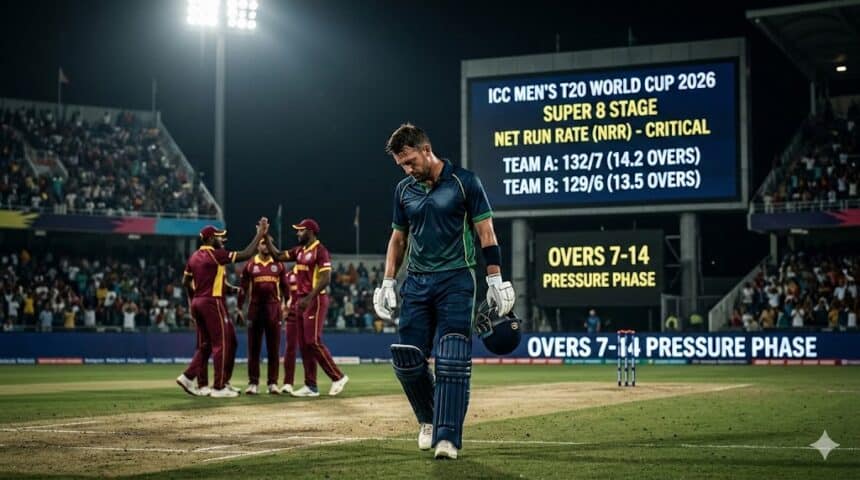
The knockout stage of the ICC Men’s T20 World Cup 2026 was not decided based on strength but on miscalculation. Some teams were not eliminated on merit but on miscalculation in phases, Net Run Rates, or in crunch overs. This tournament saw teams eliminated on minuscule differences.
Pakistan:
For Pakistan, the elimination was not about a particular loss; rather, it was the overall strategic conservatism. Despite managing 212/8 against Sri Lanka in the Super 8 group match, they only managed a five-run win, which was not enough to overcome New Zealand’s superior Net Run Rate.
Earlier, the way they pursued the totals suggested a risk-averse approach. Instead of going hard at the opposition to boost the NRR, they were only concerned with winning the matches. In a condensed format, this approach was suicidal. Throughout the Super 8 matches, the strike rates of the middle order of the Pakistan batting lineup were below 125 between overs 7-14, one of the lowest among the top eight teams.
Notably, the 1xBet platform’s odds had gradually lengthened for Pakistan’s semifinal qualification even before mainstream debate centered on NRR danger, reflecting how underlying metrics often reveal structural weaknesses earlier than narrative shifts.
Sri Lanka:
Sri Lanka’s Super 8 campaign was built on momentum, though they struggled to cope with the pressure. Their bowling strategy was not clear, especially in the middle overs, as they gave away more than 9 runs an over between overs 7 and 15. This was costly, as the pitches were conducive to spin.

Their field settings were not proactive. In the game against New Zealand, the partnership that was built after the early dismissals was not exploited, as the game was not attacked with slip-catching positions.
West Indies:
The West Indies demonstrated explosive capabilities with the top order but were unable to maintain the tempo. In the two significant matches where they lost in the Super 8 stage, they were able to score more than 50 runs in the Powerplay overs but were unable to pick up the pace in overs 8-14, where the boundary percentage was below 12%. The lack of a middle-order anchor was exposed with the fall of the top-order batsmen. The bowling was also not consistent at the death overs, with 11.6 runs conceded per over in the final five overs.
Zimbabwe:
Zimbabwe impressed with discipline but were unable to build on their competitive starts. Zimbabwe’s Powerplay economy was good, but they were unable to capitalize on the wickets. Without the breakthroughs, the pressure dissipated, and the opposition accelerated in the end.

The Semifinal Contrast
On the other hand, the four teams that progressed to the next round – India, England, New Zealand, and South Africa showed better phase awareness. They handled Net Run Rate proactively, optimized spin rotations, and excelled in death overs. South Africa, for example, averaged over 9.5 per over in the middle phases, a tournament high among the qualifiers.
For fans tracking these razor-thin shifts in probability, analytical engagement extended beyond commentary. 1xBet has an app that is convenient to use while watching matches, giving you the feeling that you are on the field, because the game is more than the field. The match is on the screen. The game is in your hands.
Conclusion
The 2026 T20 World Cup underscored a modern reality: knockout qualification depends on foresight as much as firepower. Pakistan got the margins wrong. Sri Lanka got the momentum wrong. The West Indies got the timing wrong. Zimbabwe got the finish wrong. In a format where the action is spread over 120 deliveries, tournaments are rarely lost in spectacular collapses. They are lost in quiet overs, the ones where intent fades, plans blur, and the scoreboard silently shifts.