
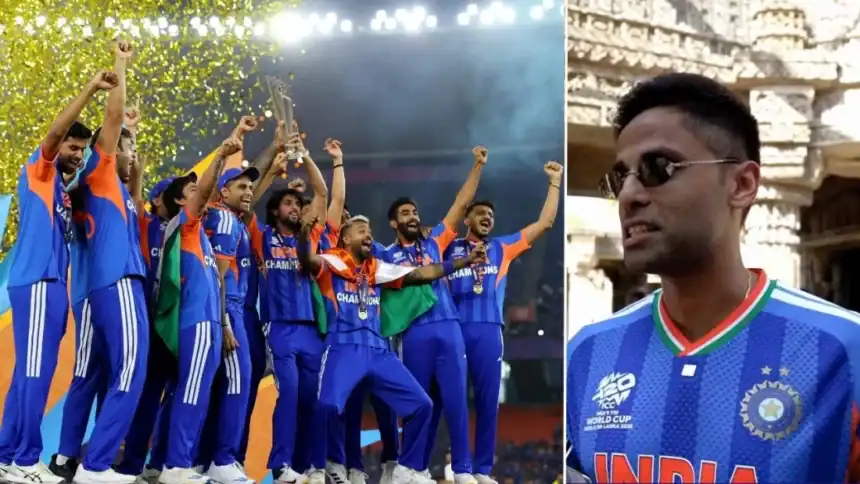
Establishing sustained dominance in cricket is never straightforward, particularly in T20 cricket, where the format’s unpredictability leaves little margin for error. The condensed nature of the game, combined with variables such as the toss, dew and rapidly shifting momentum, often prevents teams from building long periods of supremacy. In India’s case, public perception can swing dramatically, with a single result capable of altering narratives overnight.
Yet over the last two years, India have constructed a level of consistency that few sides in T20 history have managed. Their run of success in bilateral contests since the previous World Cup created an expectation that only a title triumph would validate their standing as the greatest T20 side assembled. From the outset of the tournament, their performances reflected an acute awareness of that responsibility — an understanding shaped as much by their own standards as by external scrutiny.
The defeat to South Africa served as a reminder of what was at stake. That setback underscored the significance of maintaining the standards built through two years of exceptional results. Despite their eventual triumph, the journey was far from effortless. In the lead-up to the tournament, both the captain and vice-captain endured lean spells with the bat, Harshit Rana suffered an injury during the warm-up matches, and the left-hand-heavy top order initially struggled against offspin.
Selection Flexibility and Tactical Adjustments
The team management and selectors demonstrated adaptability by prioritising current form over reputation — a shift more commonly associated with the T20 format than with Tests or ODIs. Shubman Gill stepped aside shortly before the tournament to accommodate Sanju Samson, while the strong performances of Ishan Kishan were also recognised. Midway through the competition, the decision-makers identified that three left-handers at the top was not producing the desired results, prompting Samson’s return. Even when Gill was reinstated as an opener, efforts were made to find Samson a role in the middle order, highlighting the faith placed in his abilities.
Head coach Gautam Gambhir and captain Suryakumar Yadav inherited a squad rich in depth, enabling them to integrate emerging talents such as Abhishek Sharma and Tilak Varma without dismantling the core that had delivered success in 2024. India’s resources extended beyond batting strength, with players like Jasprit Bumrah, Hardik Pandya and Axar Patel providing qualities difficult for rival teams to replicate.
More Read
Results That Match the Talent Pool
Over the past two years, India have won six out of every seven T20 matches — a remarkable return in a format designed to produce upsets. Many of these victories came in night matches under dew-heavy conditions. Notably, the team lost the toss in both the semi-final and final, yet became the first side since 2014 to bat first and win night knockouts at a T20 World Cup.
Their dominance was reflected in commanding totals exceeding 250 in both matches. This came after a strategic recalibration during the tournament, when the team chose to temper their ultra-aggressive approach and focus on efficiency rather than outright domination.
Players Who Rose to the Occasion
Individual growth played a crucial role in India’s success. Shivam Dube expanded his batting range against varied bowling attacks, while Axar Patel evolved further as a bowler. Samson capitalised on a brief period of peak form to deliver decisive contributions, and Abhishek Sharma maintained his impact despite encountering his first slump at the international level. Bumrah’s reliability remained a constant safety net, Tilak Varma adapted seamlessly to a changed role, and Hardik Pandya ensured balance by covering the need for a third specialist fast bowler.
More Read

While fortune inevitably plays a part in T20 tournaments, India’s sustained focus during training and matches allowed them to maintain a high performance level throughout the campaign. With their status as arguably the greatest T20 team now firmly established, the possibility of an even more expansive style of play looms, particularly with additional power-hitters waiting in the wings.
Challenges Beyond Familiar Conditions
A fresh test lies ahead. Since the last ODI World Cup, all three ICC tournaments have been held in conditions favourable to India, and they have maximised that advantage by losing only two matches across four events. Future assignments in South Africa, Australia and New Zealand may demand different combinations, especially given the limited scope to field multiple all-rounders in those environments.
For now, however, the focus remains on celebrating a phase in which India’s T20 cricketers have translated potential into sustained success.