
Kolkata Knight Riders’ long-standing issues in the middle overs resurfaced in their opening game of IPL 2026 against Mumbai Indians, where a slowdown during that phase proved costly in a high-scoring contest.
Despite putting up 220, KKR lost the match with five balls remaining, with the period between overs 7 and 16 once again emerging as a decisive factor.
A Changing T20 Landscape
Nearly a decade ago at the Wankhede Stadium, Ajinkya Rahane played an innings that reflected a very different era of T20 cricket. In that 2016 World Cup semi-final, he made 40 off 35 balls while India posted 192, only for West Indies to chase it down comfortably with a far more aggressive approach.
Fast forward to 2026, and the demands of the format have shifted significantly. Rahane, now leading KKR, has adapted his game accordingly, focusing more on boundary-hitting and maintaining a higher tempo.
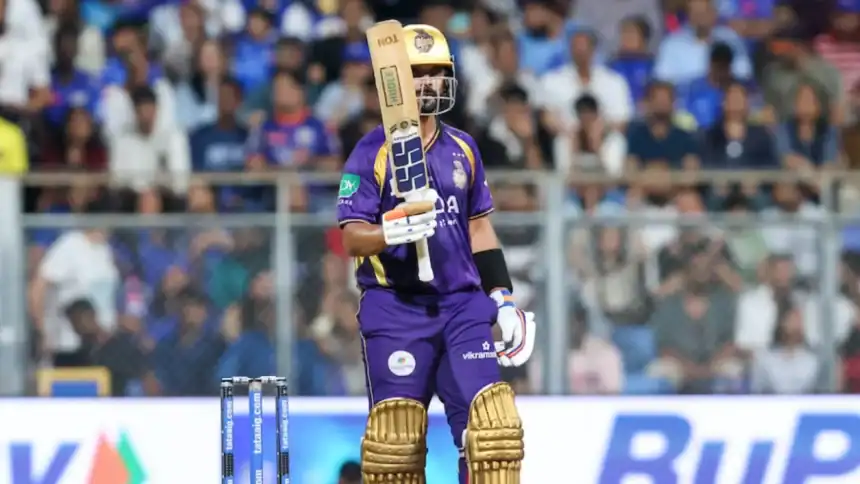
Against Mumbai Indians, he showcased that transformation with a rapid start, striking three sixes in his first nine deliveries and reaching 36 off 18 by the end of the powerplay.
More Read

Momentum Lost After Powerplay
However, the challenge in modern T20 cricket is sustaining that scoring rate beyond the powerplay. Rahane’s innings slowed after the field spread, as he added 31 off 22 balls during the middle overs.
Alongside Angkrish Raghuvanshi, he put together a 36-run partnership off 28 balls for the third wicket. By the end of that stand in the 14th over, KKR’s scoring rate had dropped from 13 to below 11.
That dip in momentum proved significant, especially in a match where both teams crossed the 200-run mark.
More Read

A Recurring Concern from 2025
This pattern is not new for KKR. During IPL 2025, they struggled in the middle overs, recording the lowest run rate (7.96) and average (20.52) among all teams in that phase.
They frequently lost wickets during this period and, even when they didn’t, failed to accelerate effectively. Among partnerships that accumulated 200-plus runs in the season, the pairing of Rahane and Raghuvanshi had one of the lowest scoring rates at 9.02.
The latest performance at Wankhede echoed those issues, reinforcing concerns about their ability to maintain momentum through the middle phase of the innings.
Changes in Personnel and Balance
Since their title-winning campaign in IPL 2024, KKR have seen significant changes in their batting line-up, losing players such as Phil Salt, Shreyas Iyer, Venkatesh Iyer, and Andre Russell.
While their overseas options—Finn Allen, Cameron Green, Tim Seifert, Rovman Powell, and Rachin Ravindra—offer depth, team composition limits mean only a few can feature in a given match.
In this game, with Green unable to bowl due to workload management considerations, KKR selected only two overseas batters. Additionally, Sunil Narine did not open the innings, which may have been to allow Rahane to bat in his preferred position.
More Read

These factors contributed to a line-up that appeared less flexible and lacked the depth seen in previous seasons.
Structural Challenges in the Middle Order
The current KKR batting unit shows signs of imbalance in the middle overs. Rahane’s evolution as a T20 batter has been notable, but his role at the top and as captain highlights the team’s reliance on him.
Raghuvanshi, though promising, is still developing the scoring tempo required for a top-order role in modern T20 cricket.
Rinku Singh remains a strong finisher against pace but is typically held back due to limitations against spin, restricting his role to specific phases of the innings.
KKR’s inability to maintain scoring momentum in the middle overs remains a key concern. The issue, which affected them throughout IPL 2025, has carried into the new season.