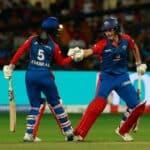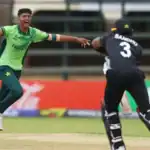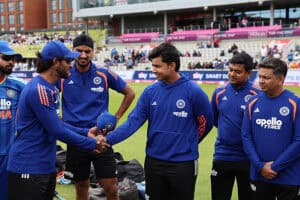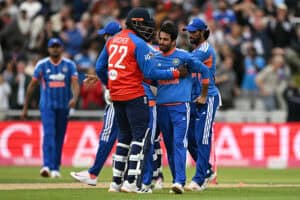

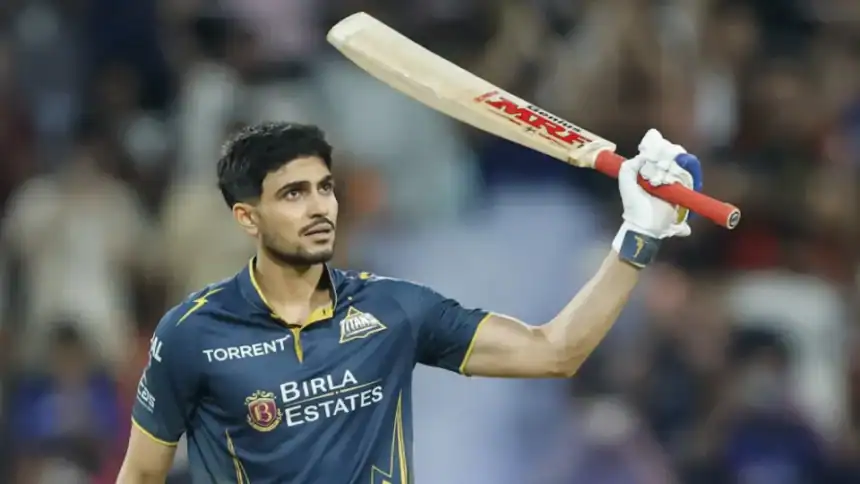
Shubman Gill and B Sai Sudharsan powered Gujarat Titans into the IPL 2026 final, overcoming another extraordinary Vaibhav Sooryavanshi innings as Rajasthan Royals fell short in Qualifier 2.
Sooryavanshi produced another remarkable performance in what has become one of the greatest batting seasons ever seen in a T20 tournament. His 96 came against the strongest bowling attack of the competition on a pitch that was not completely straightforward, but his near-solo effort was not enough to carry Rajasthan Royals into the final.
Gujarat Titans completed the second-highest successful chase in any knockout or playoff match in T20 cricket. Their victory set up a repeat of Qualifier 1 against Royal Challengers Bengaluru, although this time GT will play the final at their home ground in Ahmedabad.
Sooryavanshi ended IPL 2026 with 776 runs at a strike rate of 237.3. His 96 was as impressive as his 97 in the Eliminator, even if it came at a slightly slower tempo. He had to deal with a two-paced surface early on, a fragile RR middle order that became unsettled after an injury to Ravindra Jadeja at No. 4, and a bowling attack capable of using the conditions well.
His slowest fifty of the season still came in only 31 balls, and he eventually reached 96 from 47 deliveries before being caught at deep third with a century in sight for the second match in a row.
More Read

Sooryavanshi again produced shots that stunned the crowd, but Gill and Sudharsan made the chase look controlled from the moment Jofra Archer began with an ordinary first over. Both GT openers also moved past 700 runs for the season, but they did it with a lower-risk approach. The difference between the teams was simple: RR had Sooryavanshi, while GT had both Gill and Sudharsan.
Siraj And Rabada Make Early Impact
Mohammed Siraj and Kagiso Rabada had conceded 100 runs in seven overs between them in Qualifier 1, but Gujarat’s new-ball pair responded strongly here by taking a wicket each in their opening overs.
Both bowlers returned to hitting good and hard lengths consistently. Siraj bowled short of a length with his first four deliveries, twice striking low on Sooryavanshi’s bat before drawing a top edge from Yashasvi Jaiswal.
More Read

Rabada then removed Dhruv Jurel in the second over with a 146kph ball that seamed away and forced a mis-hit to mid-off.
The Jadeja Experiment
RR promoted Ravindra Jadeja to No. 4, most likely to give Riyan Parag and Donovan Ferreira more suitable entry points later in the innings.
Jadeja did more than simply survive the new ball. For a period, he scored faster than Sooryavanshi, who managed only one six in the powerplay. That six came straight into the sightscreen off a 153kph hard-length delivery from Rabada.
Siraj completed his powerplay spell despite carrying a shoulder injury.
Jadeja Injury Slows Rajasthan
RR were progressing smoothly before the pain from Jadeja’s tennis elbow injury flared up, forcing him to retire hurt.
Even though Rashid Khan’s first over cost 18 runs, Rajasthan lost momentum through the middle overs. Jason Holder, enjoying his best IPL bowling season, dismissed Parag and Dasun Shanaka in his first two overs, using his height and the middle of the pitch effectively.
More Read

RR continued trying to protect Ferreira’s entry point, promoting Archer and later sending Jadeja back in. From 82 for 2 after eight overs, when Jadeja first retired, Rajasthan slipped to 118 for 5 in 12.4 overs when he returned.
During that 28-ball period, Sooryavanshi faced only nine deliveries and also survived a chance when Sudharsan misjudged a catch and ran in late from deep square leg.
Sooryavanshi And Ferreira Provide Late Push
Although Jadeja struggled for rhythm after returning, he and Sooryavanshi became the first pair to record two half-century partnerships in the same T20 innings.
Sooryavanshi also set several major records, including more than 500 powerplay runs in a single tournament, the fastest to 1000 IPL runs, and the most boundaries in one tournament.
The highlight of his innings was his ability to hit hard-length deliveries over long-off and extra cover. He also created room to play an upper-cut over point.
After falling for 97 in the previous match while trying to avoid deep third, Sooryavanshi again found the same region. This time he attempted to clear the fielder, but Rabada got the bouncer high enough to draw the edge. The wicket took Rabada to 28 for the season and helped him reclaim the Purple Cap.
Rashid’s difficult night continued in the final over, when Ferreira hit him for four sixes down the ground from the crease.
Archer Misfires As Gill And Sudharsan Take Control
With the ball, RR again depended heavily on Archer, who had taken seven first-over wickets during the season. This time, however, he gave width to Sudharsan twice and drifted onto Gill’s pads twice.
The pitch also appeared to improve for batting in the second innings. The spongy bounce faded, the ball began to skid on, and Gill and Sudharsan raised risk-free hitting to another level.
Sudharsan started quickly and survived a chance on 14 off 8, but Gill soon caught up and then moved ahead with elegant strokeplay after the powerplay. While Sooryavanshi had needed to clear fielders, Gill seemed to find gaps almost everywhere during the chase.
Gill’s hundred was the fastest by a Gujarat Titans batter. His century partnership with Sudharsan was their world-record 11th together, and the chase became GT’s highest.
The strangest moment of the night belonged to Sudharsan, who lost his bat while hitting a ball to the off-side square boundary for the second time in two nights and was dismissed hit-wicket again.