
New Zealand 168 for 7 (Santner 47, Ravindra 32, McConchie 31, Theekshana 3-30, Chameera 3-38) beat Sri Lanka 107 for 8 (Kamindu 31, Ravindra 4-27, Henry 2-3) by 61 runs*
A remarkable lower-order fightback from Mitchell Santner and Cole McConchie ended Sri Lanka’s 2026 T20 World Cup campaign despite the hosts’ electric opening burst. New Zealand completed a commanding 61-run victory to seal their progress.
In front of a vibrant crowd at Premadasa Stadium, Sri Lanka’s spin attack dismantled New Zealand’s top and middle order, reducing them to 84 for 6. Just when the innings appeared set for a modest finish, Santner and McConchie launched a powerful counter-assault across the final four overs.
McConchie set the tone by taking on Dushmantha Chameera, before Santner targeted Maheesh Theekshana, who had until then been the standout bowler. The closing four overs yielded 70 runs, with the pair adding 84 for the seventh wicket — the highest such partnership in T20 World Cup history.
That late surge proved decisive. Sri Lanka never recovered from it. Pathum Nissanka fell to the very first delivery of the chase, undone by Matt Henry’s inswinger, and Charith Asalanka followed in Henry’s next over. From there, the hosts retreated as New Zealand tightened their grip through spin.
More Read

Rachin Ravindra, who had featured in a secondary bowling role in India, stepped up in Colombo. He struck twice in his opening over and finished with 4 for 19 — his best T20I figures. By the time the innings drifted toward its conclusion, the result was beyond doubt. Sri Lanka closed on 107 for 8, bowing out of the tournament as the expectant crowd was left disappointed.
Theekshana’s Rollercoaster Outing
It was a day of sharp contrasts for Theekshana. His evening began poorly when he spilled a diving chance at short third off Tim Seifert from Dilshan Madushanka’s bowling, drawing visible frustration from the seamer.
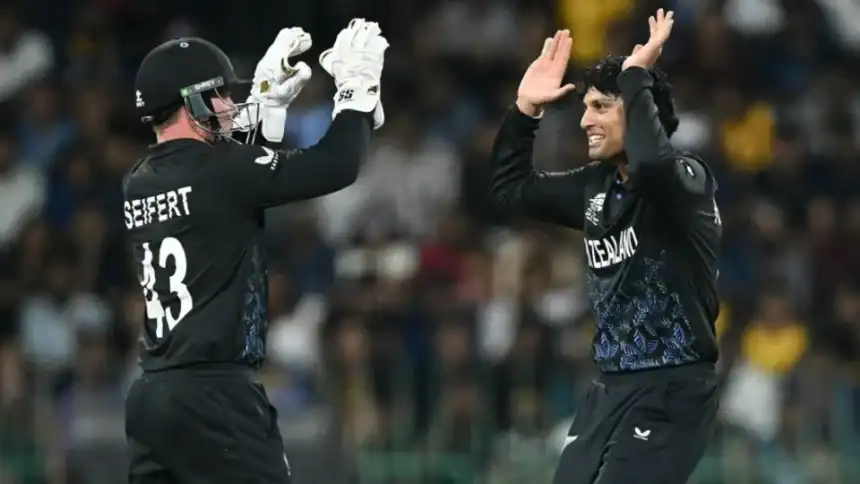
He responded swiftly in the next over, producing a sharp return catch off his own bowling to dismiss Finn Allen.
More Read

That sparked a superb spell in which he triggered a New Zealand collapse, removing Ravindra and Mark Chapman within three deliveries. At that point, his figures stood at 3-0-9-3. However, the late onslaught took its toll, with Santner striking 21 off his final over as the run flow proved impossible to contain.
Henry’s Early Blows Derail the Chase
Carrying momentum from the first innings, Henry ensured Sri Lanka’s pursuit faltered immediately.
With the opening ball, he delivered a fierce inswinger that beat Nissanka’s inside edge and crashed into the stumps, beginning a wicket-maiden. Having made the breakthrough, he returned to claim another at the start of a subsequent over, as Asalanka miscued a lofted shot into the infield.
McConchie and Santner compounded the damage during the powerplay, conceding just 14 runs across their combined three overs inside the first six. Sri Lanka limped to 20 for 2 at the end of the powerplay — the lowest six-over total recorded in the tournament.
Ravindra Leads New Zealand’s Spin Masterclass
After playing much of their World Cup cricket on Chennai’s flatter pitches, New Zealand displayed their adaptability in Colombo. The surface demanded a different approach, and the visitors adjusted accordingly. McConchie replaced James Neesham to bolster the bowling resources, while Ish Sodhi featured for the first time in the tournament aside from the washed-out Pakistan fixture.
Ravindra epitomised that adaptability with a career-best effort, claiming four wickets and dismantling Sri Lanka’s middle order. In total, New Zealand deployed five separate spin options, sending down only three overs of seam across the innings — the fewest they have bowled in a completed T20I innings.