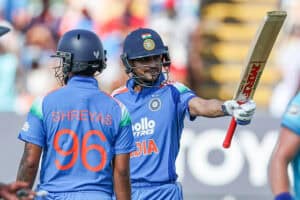

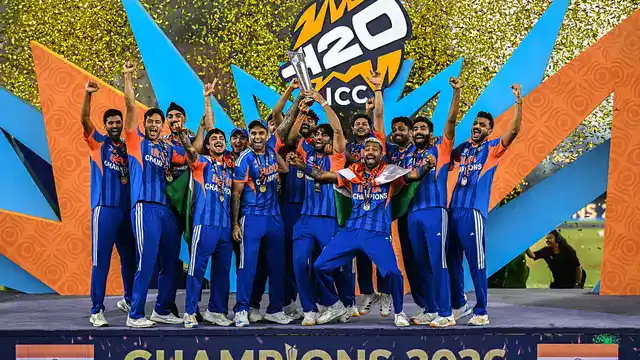
India created several historic milestones during the T20 World Cup final against New Zealand in Ahmedabad. The victory not only secured another global title but also produced multiple statistical achievements across batting, bowling, and team records.
India Achieve Historic Tournament Milestones
India became the first team to win the T20 World Cup three times, having previously lifted the trophy in 2007 and 2024. West Indies (2012 & 2016) and England (2010 & 2022) have each won the tournament twice, while Pakistan (2009), Sri Lanka (2014), and Australia (2021) have claimed the title once.
The win also made India the first team to successfully defend the T20 World Cup trophy and the first to secure the championship on home soil.
India’s total of 255/5 in the final is the highest score ever recorded in a T20 International final. Across all T20 tournament finals, only Jharkhand’s 262/3 against Haryana in Pune in the Syed Mushtaq Ali Trophy 2025/26 stands higher.
The 96-run victory margin is the fourth-largest in a T20I final and the biggest achieved by a Full Member nation.
More Read

India’s 92/0 in the Powerplay matched the highest Powerplay total in T20 World Cup history, equalling West Indies’ 92/1 against Afghanistan in Gros Islet in 2024. The previous highest Powerplay total in a knockout match in the tournament was 84/0 by New Zealand against South Africa at Eden Gardens in the semifinals of this edition. It also ranks as India’s third-highest Powerplay score in T20 Internationals.
Individual Records And Milestones
Abhishek Sharma
- His 18-ball fifty is the fastest in the knockout stages of the T20 World Cup, surpassing the 19-ball fifties by Finn Allen and Jacob Bethell in the semifinals of this edition.
- It was the fourth time he reached a half-century in fewer than 20 balls in T20Is, the most by any batter.
- The previous joint record of three such knocks was held by Finn Allen, David Warner, Phil Salt, Colin Munro, and Yuvraj Singh.
Sanju Samson
Sanju Samson continued his remarkable run of form with scores of 97, 89, and 89* in his last three T20Is.
He became only the second batter to record three consecutive scores of 85 or more in T20Is, after France’s Gustav McKeon, who posted 76, 109, 101, and 87 in his first four innings in the format.
More Read

Samson also:
- Became the seventh batter to score 50+ in three or more successive T20 World Cup innings.
- Became the third Indian to achieve the feat after Virat Kohli (2016–21) and KL Rahul (2021).
- Became the third player to score 50+ in both the semifinal and final of a T20 World Cup after Shahid Afridi in 2009 and Virat Kohli in 2014.
Samson’s 24 sixes in the tournament set a new record for the most sixes by a batter in a single T20 World Cup edition. The previous highest across the first nine editions was Nicholas Pooran’s 17 in 2024, which now sits in joint fifth position.
Among batters from Full Member nations, only Finn Allen has struck more sixes in a series — 25 against Pakistan in five T20Is at home in 2024. Zimbabwe’s Sikandar Raza also hit 24 sixes in the African Regional Qualifiers in 2024.
In the final, Sanju Samson (89), Abhishek Sharma (52), and Ishan Kishan (54) became the first instance of the top three batters all scoring half-centuries in a T20 World Cup innings. Overall, it was the fifth occurrence of three 50+ scores in a T20I innings and the first in a knockout match.
India Rewrite T20 Batting Records
India finished the tournament with 106 sixes across nine matches, becoming the first team to hit 100 or more sixes in a single T20 competition.
Earlier in 2026, India had hit 69 sixes in five matches against New Zealand in a bilateral series preceding the tournament. That brought their tally to 87 sixes in six games against New Zealand in 2026, the second-highest by a team against a single opponent in a calendar year. The only higher figure remains Cambodia’s 111 sixes against Indonesia in 2025 (across 17 T20Is).
More Read

A total of seven overs in the final produced 20 or more runs — six by India and one by New Zealand. Across the previous nine T20 World Cup finals combined, there had been only seven such overs.
India struck 24 runs in three separate overs — the 4th and 12th overs bowled by Lockie Ferguson and the 20th over bowled by James Neesham. This equals the most expensive over in a T20 World Cup final, matching Ben Stokes in 2016 and Axar Patel in 2024, who also conceded 24 runs in an over.
Jasprit Bumrah Leads The Bowling Records
Jasprit Bumrah reached 40 wickets in T20 World Cups, the most by any fast bowler in the tournament’s history, surpassing Lasith Malinga’s 38 wickets.
His figures of 4/15 in the final are the second-best bowling figures in a T20 World Cup final, behind Ajantha Mendis’ 4/12 against West Indies in Colombo (RPS) in 2012.
Best bowling figures in T20 World Cup finals
- Ajantha Mendis – 4/12 vs WI, Colombo (RPS), 7-Oct-12
- Jasprit Bumrah – 4/15 vs NZ, Ahmedabad, 8-Mar-26
- Sunil Narine – 3/9 vs SL, Colombo (RPS), 7-Oct-12
- Sam Curran – 3/12 vs Pak, Melbourne, 13-Nov-22
- Irfan Pathan – 3/16 vs Pak, Johannesburg, 24-Sep-07
- Josh Hazlewood – 3/16 vs NZ, Dubai, 14-Nov-21
Bumrah also joined a select group of players who have won Player of the Match in a final and Player of the Tournament in the same edition. Before him, this feat had been achieved by Shahid Afridi (2007 & 2009), Sam Curran (2022), and Virat Kohli (2014, 2016, and 2024).
Notably, Bumrah had also been named Player of the Tournament in the 2024 T20 World Cup held in the Caribbean and USA.