
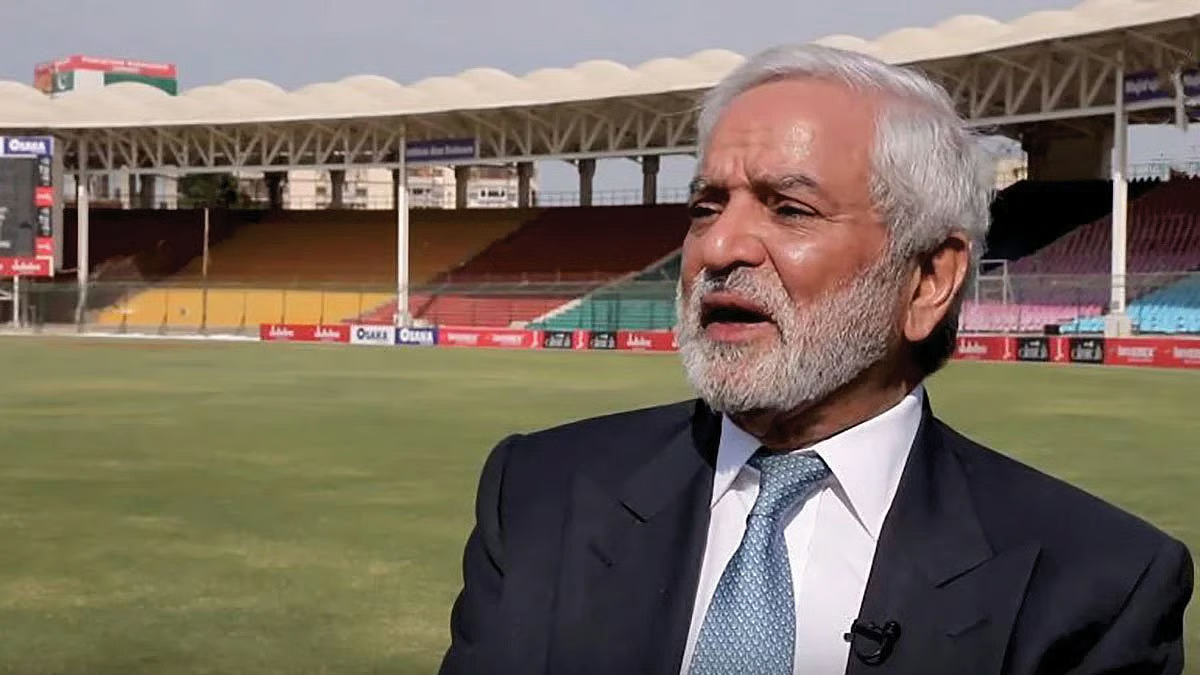
In a significant escalation of cricketing tensions, former PCB Chairman and ex-ICC President Ehsan Mani has asserted that the International Cricket Council (ICC) lacks the authority to penalize the Pakistan Cricket Board (PCB) for its decision to skip the T20 World Cup 2026 clash against India. This high-stakes boycott, scheduled for February 15 in Colombo, follows a direct order from the Pakistani government. Mani argues that because the PCB is acting under government mandate, the ICC cannot legally impose punitive measures without appearing to hold “double standards.”
Mani’s stance centers on a precedent set during the 2025 Champions Trophy, where the Indian government prohibited the BCCI from traveling to Pakistan. At that time, the ICC accommodated the situation by adopting a hybrid model and did not sanction the Indian board. According to Mani, the ICC has essentially “left the door open” for any nation to cite government intervention as a shield against the repercussions of selective participation.
The Logic Behind the Shield
The debate over whether the ICC can or will act hinges on several key political and procedural points:
- Government Supremacy: Mani contends that no cricket board can be sanctioned for obeying its sovereign government’s instructions, a principle he claims was validated by India’s recent actions.
- Precedent of Forfeiture: In previous World Cups, teams like Australia (1996), England (2003), and New Zealand (2003) have forfeited specific matches due to political or security concerns without facing long-term bans or financial penalties.
- ICC’s Procedural Trap: By failing to address the “government directive” loophole earlier, Mani suggests the ICC has placed itself in a position where it cannot fairly punish one member while having pardoned others for similar behavior.
Despite these arguments, the ICC has released a stern warning, noting that “selective participation” threatens the integrity of global events. While Mani believes the PCB is legally protected, the ICC could still explore indirect financial penalties, such as deducting revenue shares or withholding hosting fees, to compensate broadcasters who face massive losses without an India-Pakistan fixture.
What Lies Ahead for the T20 World Cup?
The Pakistan team, led by Salman Ali Agha, is still set to participate in the remainder of the tournament starting February 7. However, the February 15 slot in Colombo will likely result in a walkover for India. The Pakistani government has not yet clarified whether this boycott extends to potential knockout stages should the two rivals meet again later in the competition.
More Read

As the ICC prepares for a high-level meeting in the next 48 hours to discuss the fallout, the cricketing world remains on edge. The outcome will likely redefine the balance of power between international sporting bodies and the national governments that influence them.