
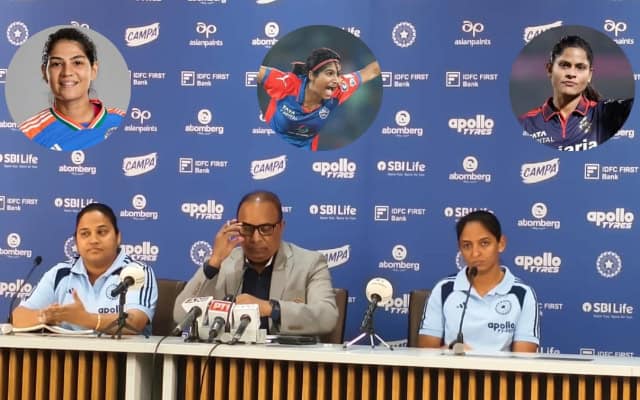
India’s Women’s T20 World Cup squad announcement has drawn attention for a few selections labelled as “surprising.” However, a closer assessment of team composition, injuries, and recent performances suggests these decisions were largely expected rather than unexpected.
The 15-member squad reflects a balance shaped by availability and role requirements, with several inclusions driven by practical needs within the lineup.
Yastika Bhatia: Cover at the Top and Behind the Stumps
India required both a reserve wicketkeeper and a backup option for the top order. Yastika Bhatia’s inclusion addresses both needs. She had missed the ODI World Cup 2025 due to a knee injury, during which Uma Chetry stepped in. While Chetry provided cover behind the stumps, her returns as a top-order batter were limited, scoring 28 runs across three T20I innings at an average of 9.33 and a strike rate of 82.35.
Other alternatives were explored. Harleen featured in the Australia series but did not play, and her recent T20I numbers — 60 runs in three innings at an average of 20 — did not strengthen her case. Anushka Sharma, trialled against South Africa, showed promise but remains a developing option better suited to India A exposure at this stage.
With G Kamalini also impacted by injury, the final choice narrowed to Bhatia and Chetry. Bhatia’s technique and experience, including overseas exposure, made her the preferred option.
More Read

Nandini Sharma: Filling the Death-Bowling Role
Nandini Sharma’s selection follows a strong Women’s Premier League 2026 campaign, where she picked up 17 wickets in 10 innings, finishing as joint highest wicket-taker.
Her inclusion also addresses a specific tactical need. With Amanjot Kaur and Kashvee Gautam unavailable due to injury, India required a pace option capable of operating at the death. Other contenders, including Saima Thakor and Jintimani Kalita, did not offer the same impact, either in recent tournaments or in death-overs roles.
Nandini’s effectiveness in the closing overs, highlighted by 12 wickets in 15 overs at the death in WPL 2026, provided a clear justification for her selection.
More Read

Radha Yadav: All-Round Balance
Radha Yadav’s inclusion adds balance to the squad, particularly with limited batting depth among the pace options. Following injuries to two pace-bowling all-rounders, India needed a player who could contribute in both departments.
Her recent performances underline that role. In WPL 2026, she scored 114 runs in six innings at a strike rate of 140.74, alongside taking two wickets. In the Rising Stars Asia Cup, she added 75 runs and claimed 10 wickets, finishing as joint highest wicket-taker.
Additionally, her fielding ability remains a significant asset, offering value even when not part of the playing XI.
A Logical Squad Composition
While initial reactions labelled some selections as unexpected, the final squad reflects a structured approach based on role clarity and squad balance. Injuries, recent form, and specific tactical requirements have shaped the final group.
Rather than surprising decisions, the selections highlight a methodical process, with each inclusion addressing a defined need as India prepare for the T20 World Cup.