
Twenty-five years ago, optimism around Indian cricket was scarce. Still grappling with the fallout of the match-fixing scandal and searching for stability, the side found itself hosting Steve Waugh’s formidable ‘Invincibles’. What followed at Eden Gardens would go on to redefine the trajectory of Indian cricket. Let’s looks back at this defining chapter.
Eyes sparkling, she hurried down the stairs before suddenly pausing. The ground-floor lobby at Eden Gardens was packed with journalists, officials and onlookers as the Indian captain, barely a year into his tenure, stepped out of the dressing room, pushed open the glass door and moved into the jubilant crowd. Sourav Ganguly, still in his whites, glanced up, flashed a radiant smile at Mrs Ganguly and remarked in a raised voice, “After the press conference…”
Yet his expressive eyes conveyed an uncontainable joy that has endured across the passing years. “Yes, we did it, love,” he communicated simply.
Time softens many memories, but that brief moment — and the events leading up to it at Eden Gardens — continues to shine brightly in Indian cricket history, long after Steve Waugh’s “Invincibles” departed from what proved to be their toughest challenge.
It was the summer of 2001. Indian cricket was desperate to move beyond the lingering shadow of the match-fixing controversy. The Board of Control for Cricket in India (BCCI) had handed former captain Mohammed Azharuddin a lifetime ban and imposed a five-year suspension on Ajay Jadeja. Sachin Tendulkar had stepped away from captaincy, leaving a vacuum that demanded urgent leadership. In this unsettled environment, Ganguly was entrusted with guiding a drifting side — a decision that would later yield rich rewards.
More Read

The team began positively with a 3-2 One-day series victory over South Africa. Soon after, Steve Waugh’s Australian side arrived for a three-Test contest, riding a streak of 15 consecutive Test wins. Comparisons with Donald Bradman’s Invincibles of 1948 were widespread, and Australia reinforced their dominance in Mumbai, wrapping up the opening Test inside three days to stretch their run to 16 victories.
Kolkata — renamed only two months earlier — became the next venue. Waugh produced a century, his only one in India, while his bowlers, led by the relentless Glenn McGrath and Shane Warne, exposed familiar frailties in the Indian line-up and set up a daunting challenge.
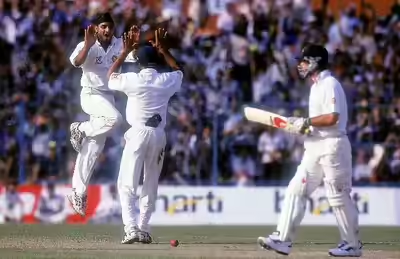
A brief yet significant disruption unsettled the Australians in the first innings. A lively young off-spinner, later known as Bhajji, dismissed Ricky Ponting and Adam Gilchrist off successive deliveries before removing Shane Warne with the third, becoming the first Indian to claim a Test hat-trick. Harbhjahan Singh’s spirited spell (7/123) ignited hope among the packed crowd, hinting at a contest still alive.
More Read

The visitors, however, failed to fully recognise the shift in momentum. Many observers in the press box remained convinced that an Australian win was inevitable. Ganguly’s side, though, had no intention of conceding without a fight.
After India were bowled out in the first innings, Waugh enforced the follow-on — a call he would regret by the time Harbhajan delivered the final ball as evening shadows stretched across the Eden pitch three days later. VVS Laxman, who had crafted a resilient half-century amid the initial collapse, was promoted to No. 3 for the second innings.
Throughout Day Four, Laxman and Rahul Dravid constructed a partnership of remarkable endurance and artistry. The contest was transformed. The scale of Australia’s reversal was underscored by the fact that it marked Adam Gilchrist’s first defeat in Test cricket since his debut in November ’99, 15 matches earlier.
The outcome altered not only the match but also the direction of Indian cricket under the determined Ganguly, who had earlier kept the visiting captain waiting at the toss — a symbolic gesture of intent. Challenging the opposition both mentally and strategically became a hallmark of his leadership, something rarely seen in Indian cricket before.
Reflecting on the setback, the Australian captain remarked, “The sun will rise tomorrow.” For Ganguly’s India, it shone brightly.
The deciding Test in Chennai proved equally intense, with Harbhajan claiming 32 wickets across the series as India secured a memorable triumph over a dominant opponent. While the full impact of the victory was not immediately evident, the Eden Gardens encounter represented a turning point — a moment when the team began its journey from uncertainty towards sustained sporting achievement.
More Read

Even a quarter-century later, the Eden Test remains a topic that continues to stir reflection without losing its emotional resonance.
Before the start of the second Test at Eden Gardens, Kolkata in March 2001, Australia, with their ten-wicket triumph in the first Test at Wankhede Stadium, Mumbai had extended their winning streak to sixteen, the best by any team in Tests. They had taken a 1-0 series lead.