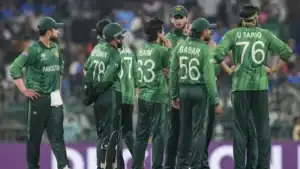

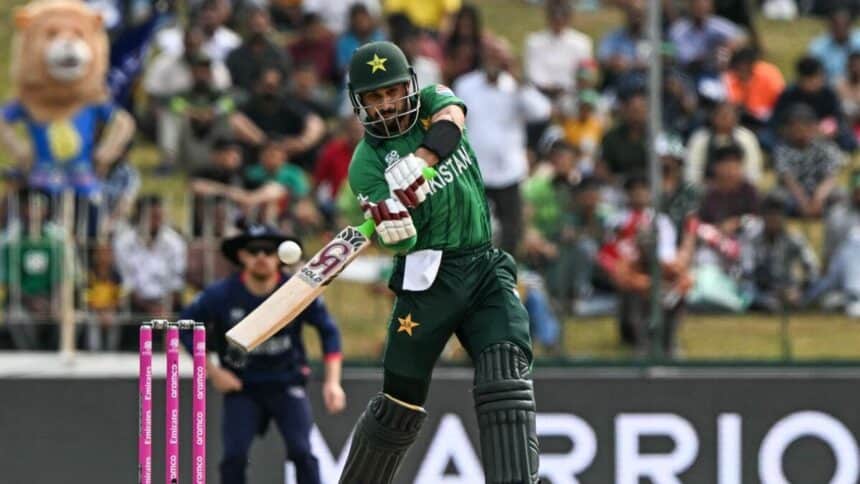
Pakistan opener Sahibzada Farhan has underlined the need to adapt to match situations in T20 cricket, even while maintaining attacking intent when the opportunity presents itself.
Farhan’s prolific run has masked frailties in Pakistan’s batting during this T20 World Cup. With 220 runs from four innings, he is currently the tournament’s leading run-scorer. His century against Namibia was only the second by a Pakistani batter in T20 World Cups.
“We have collapsed in our batting. We are doing well with our bowling, the spinners particularly. But we will have to think about batting because if you look at T20 cricket, your top three or top four should be able to score more runs. We have not been able to do that. But the boys are working hard, and they are focused on the next match,” Farhan said.
The numbers across Pakistan’s top order underline the imbalance. Saim Ayub, Salman Ali Agha and Babar Azam — the other members of the top four — have managed a combined 184 runs. Shadab Khan, batting at number five or lower, stands as the next highest scorer with 88 runs.
Debate over Babar’s revised batting position and the shortage of runs has added to the scrutiny. Farhan, however, stressed collective responsibility.
More Read

“Sometimes the top order gives you a good partnership, sometimes it’s the middle order. T20 is such that it doesn’t depend on one person. I think this is a team game and everyone should take responsibility,” Farhan said.
At 29, Farhan has embraced that responsibility. Known for taking time to settle, he has adjusted his approach to increase tempo at the start of the innings. Across his 44-match T20I career, he has scored in the PowerPlay at a strike rate of 129.68, a figure that has risen to 163 during this World Cup.
That shift, coupled with the limitations further down the order, has amplified the importance of his contributions.
More Read

“This is international cricket. No matter how good you are, you cannot come and hit the first ball for six. So, you have to watch the pitch and play according to that. But I try, if a ball is in my range, I try to attack it, which you must have seen. But when I find my momentum, I try to take it long,” Farhan said.
He demonstrated that adaptability against Namibia. His first half-century came off 37 deliveries before he accelerated sharply, bringing up the next 50 runs in just 20 balls.
“It is important to score runs, irrespective of the team you are playing against. You will get confidence. But I want to apply my form to all the Super Eight matches so that the team can benefit as well,” Farhan said.
Up next is England, where Farhan could come up against Jofra Archer’s pace. Archer’s preference for length and hard-length deliveries is notable, with Farhan having been dismissed 19 times to those areas.
“It is no big deal to face Jofra Archer. We have faced him earlier too. We also have good wickets back home and bowlers who can bowl at 145 (kmph). You said that he must have planned how to bowl against me. But I have also planned. Hopefully, we will have a good contest,” Farhan said.
With two matches remaining, Farhan is closing in on Babar Azam’s mark of 303 runs for the most in a single World Cup edition. Virat Kohli’s 319 runs in 2014 is also within reach.
More Read

Still, Farhan insists team success outweighs personal landmarks. “I don’t look at the stats. Even when I perform well, people come and tell me that I have scored so many runs. You have to take risks in T20s. You cannot take the added burden on yourself of wanting to break records. Records are meant to be broken. I am not focused on that, but I will try my best,” Farhan said.