

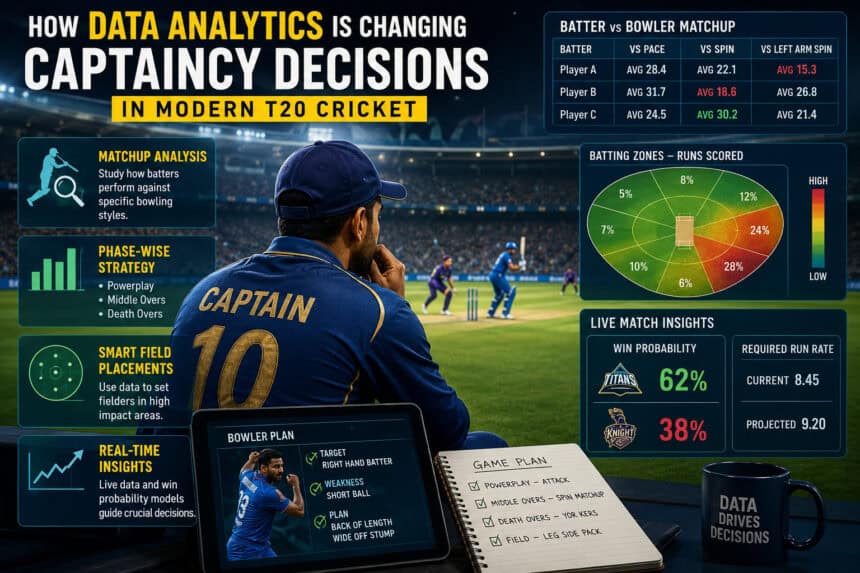
Modern T20 cricket has become much more than just talent and instinct. Today, captains and coaches rely heavily on numbers, player records, and match data to make important decisions on the field. From bowling changes to field placements, almost every tactical move is now influenced by analytics.
The question “How is data analytics used in cricket?” has become more important than ever because teams across leagues like the IPL and international cricket now use advanced analysis systems during matches. T20 cricket has turned into a fast-moving tactical battle where information can often become the difference between winning and losing.
The Rise of Matchup-Based Captaincy
One of the biggest changes in data analytics in T20 cricket captaincy is the use of player matchups.
Captains no longer look only at a batter’s overall record. Instead, teams study how players perform against very specific bowling styles. For example, if a batter struggles against left-arm spin, captains may immediately introduce that type of bowler even if it was not part of the original plan.
Teams also study weaknesses based on pace, length, and shot selection. If analytics show that a batter struggles against short-pitched fast bowling, captains will adjust their bowling rotation to target that weakness directly.
More Read

This approach has made captaincy more strategic and less dependent only on instinct.
Analytics Have Changed Every Phase of T20 Cricket
How analytics changed cricket tactics becomes clearer when looking at how teams manage different phases of a T20 innings.
During the powerplay, teams use data to decide whether they should attack for wickets or focus on controlling the run rate. Earlier, captains often used their best bowlers immediately. Now, analytics sometimes suggest saving strike bowlers for later depending on the opposition’s batting style.
More Read

In the middle overs, spinners are often used according to matchup data rather than traditional bowling rotations. Captains carefully study which batters are uncomfortable against spin and target those phases aggressively.
The death overs have become even more data-driven. Teams analyze batting scoring areas, often called wagon wheels, to decide exact field placements. If a finisher scores heavily on the leg side, captains place more fielders in those regions and ask bowlers to target wider lines outside off stump.
The use of data in T20 cricket strategy has made modern captaincy far more detailed than before.
The Dugout Has Become a Tactical Control Room
Another major development is the increasing role of analysts during live matches. Modern captains regularly communicate with support staff during timeouts and innings breaks.
Analysts track live match situations and provide updates about scoring patterns, required run rates, and opposition weaknesses. Many teams also use win probability models that estimate the team’s chances based on the current match situation.
This information helps captains decide whether to attack aggressively or play more safely during crucial moments.
More Read

In run chases, teams now often follow pre-planned scoring targets for specific overs instead of depending only on natural momentum. Certain bowlers are identified as scoring opportunities, while stronger bowlers are approached more carefully.
The Role of the Captain Has Changed
Because of analytics, the role of a captain has evolved significantly. Earlier, captains were mainly known for instinctive decision-making and reading the game naturally.
Today’s captains still need strong cricket knowledge, but communication and adaptability have become equally important. Modern leaders must understand data, trust analysts, and ensure players follow tactical plans under pressure.
That does not mean instinct has disappeared completely. Instead, instinct now works together with information.
The Future of T20 Cricket
Data analytics has completely transformed the way T20 cricket is played and managed. Captains are no longer making decisions based only on experience or emotions. Every bowling change, field placement, and batting strategy is now supported by detailed analysis.
As technology continues to improve, analytics will become even more important in shaping the future of modern T20 cricket.