

While much of the sporting world is focused on the FIFA World Cup and the ICC Women’s T20 World Cup, India and Afghanistan are preparing for a series that could have significant long-term importance.
The upcoming three-match ODI series in India may not carry the pressure of a major tournament, but it marks the beginning of a new cycle leading toward the 2027 ICC Men’s Cricket World Cup in South Africa, Zimbabwe, and Namibia. It is also a historic occasion, as the two sides meet in their first-ever bilateral ODI series.
For both teams, the focus extends beyond immediate results. This series is about building combinations, testing depth, and laying foundations for the future.
India Begin a New Chapter
India enter the series in transition mode.
Several established names are unavailable, creating opportunities for younger players to stake their claim. While the batting unit still contains significant experience, the bowling attack offers a glimpse into the next generation of Indian cricket.
Much of the attention will fall on emerging pacers Prince Yadav and Gurnoor Brar, both of whom are pushing for ODI debuts. Alongside Prasidh Krishna and Arshdeep Singh, they represent India’s effort to strengthen its fast-bowling resources ahead of future overseas challenges.
The series also provides another important opportunity for Nitish Kumar Reddy. The all-rounder continues to grow in stature and could become a valuable backup option whenever India are without Hardik Pandya.
With Shubman Gill leading the side, India’s focus is clearly on preparing for the next major cycle rather than simply winning a short bilateral contest.
More Read

Afghanistan Arrive With Confidence
Afghanistan may enter the series as underdogs, but they possess enough quality to challenge any opponent.
The visitors have won their last four completed ODIs and continue to benefit from a core group that gained valuable experience during the 2023 ODI World Cup in India.
Captain Hashmatullah Shahidi leads a settled batting lineup featuring Ibrahim Zadran, Rahmanullah Gurbaz, and Rahmat Shah, while the return of Rashid Khan significantly strengthens the bowling attack.
Perhaps the most important player, however, is Azmatullah Omarzai.
The pace-bowling all-rounder has become one of Afghanistan’s most influential performers. His ability to contribute with both bat and ball gives Afghanistan balance and flexibility, particularly against strong opposition.
Key Selection Questions
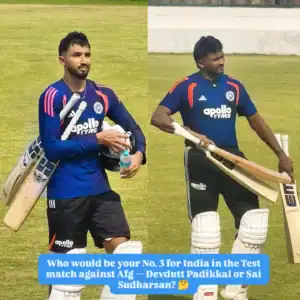
India’s biggest selection discussion revolves around the No. 3 position.
More Read

With Virat Kohli unavailable, Ishan Kishan appears the leading candidate to occupy the role. His aggressive style could provide India with a different dynamic in the top order alongside Rohit Sharma and Gill.
The bowling combination also remains under scrutiny. India’s management will be keen to assess how their young fast bowlers handle pressure in ODI cricket.
Afghanistan face questions of their own. Veteran all-rounder Mohammad Nabi remains doubtful due to illness, while fast bowler Mohammad Saleem could earn an opportunity after impressing during the recent Test match between the two sides.
Players to Watch
Shubman Gill (India)
Already one of the world’s premier batters, Gill enters the series as captain and one of the central figures in India’s long-term plans. He is also closing in on 3,000 ODI runs and will be eager to lead from the front.
Rashid Khan (Afghanistan)
Afghanistan’s biggest match-winner returns to ODI cricket after another impressive franchise season. His ability to control the middle overs could prove decisive against India’s powerful batting lineup.
Nitish Kumar Reddy (India)
The all-rounder continues to establish himself as a genuine multi-format option. Strong performances here would further strengthen his case as an important part of India’s future.
Azmatullah Omarzai (Afghanistan)
Few players have been more consistent for Afghanistan in recent years. His contributions with both bat and ball make him one of the most complete all-rounders in world cricket.
More Than Just a Bilateral Series
The first ODI between India and Afghanistan may not attract the global attention of a World Cup match, but its significance should not be underestimated.
For India, it is the beginning of a new journey toward 2027, with fresh faces receiving opportunities to prove themselves. For Afghanistan, it is another chance to demonstrate how far they have come as an international side.
The road to the next World Cup is still long, but every cycle begins somewhere. For both teams, that journey starts now.